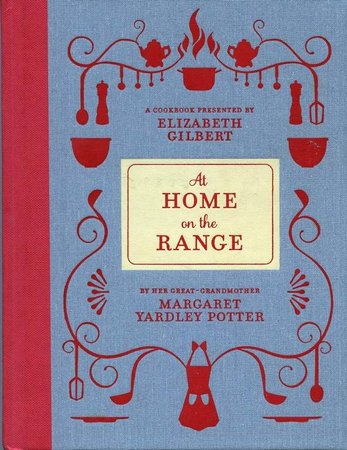
The sights of sleepy Frenchtown, New Jersey, include several horse farms, three steepled churches, and, in front of one yellow Victorian house, a large supine Buddha. The deity reclines on the lawn of the writer Elizabeth Gilbert, who greeted a visitor recently wearing an apron on which was scrawled, “In her presence flowers blossomed, bees buzzed, and the sun shined brighter than before.” Gilbert was about to attempt a recipe for Celery au Gratin from the cookbook “At Home on the Range; or, How to Make Friends with Your Stove,” which was published in 1947, by her great-grandmother Margaret Yardley Potter.
The barefoot author bore little physical resemblance to her predecessor, who died before she was born (“Well, you must be the one who cooks,” someone said of Potter, upon meeting her and her sister). But both Potter, a marmish débutante-turned-housewife with a drinking problem, and Gilbert, an ashram-hopping exemplar of self-discovery, have something of the guru about them. Both writers dispense aphorisms with a wink—the elder on learning to love dandelion greens and cockscombs with wine in the heyday of Jell-O, the younger on learning to love oneself, post-marital meltdown
What book is on your night stand now?
“Rome,” by Robert Hughes. Though I’m finding it challenging to read about Rome without immediately wanting to run away to Rome.
When and where do you like to read?
When I am awake, and wherever I happen to be. If I could read while I was driving, showering, socializing or sleeping, I would do it.
What was the last truly great book you read?
Nothing in the last few years has dazzled me more than Hilary Mantel’s “Wolf Hall,” which blew the top of my head straight off. I’ve read it three times, and I’m still trying to figure out how she put that magnificent thing together. Now I’m on to its sequel, “Bring Up the Bodies,” which is nicely satisfying my need for more Thomas Cromwell.
Are you a fiction or a nonfiction person? What’s your favorite literary genre? Any guilty pleasures?
I enjoy both, although I unfairly hold fiction to a far higher standard. With nonfiction, I figure I can glean something educational or interesting out of the book even if the writing is weak. But if the first chapter of a novel doesn’t feel perfect and accurate to me, I simply can’t read on; it’s too painful. Meanwhile, my (very) guilty pleasure is tabloid journalism. I hate to say it, but I know the names of all the celebrities’ babies.

Part 2 of the TED Radio Hour episode The Creative Process.
The author of Eat, Pray, Love, Elizabeth Gilbert has thought long and hard about some large topics. Her next fascination is genius and how we ruin it. In this TEDTalk, Gilbert muses on the impossible things we expect from artists and geniuses — and shares the radical idea that, instead of the rare person “being” a genius, all of us “have” a genius.
Elizabeth Gilbert faced a pre-midlife crisis by doing what we all secretly dream of — running away for a year. Her travels through Italy, India and Indonesia resulted in the mega-bestselling memoir Eat, Pray, Love, about the process of finding herself by leaving home. The book was on The New York Times bestseller list for 187 weeks.
FRENCHTOWN, N.J. — Elizabeth Gilbert is standing at her stove, stirring flour into melted butter, attempting a simple white sauce for the base of an oyster bisque. As she slowly adds the milk, just as directed in the recipe, the sauce clumps.
“I don’t know about this, I’ve never made a white sauce before,” she says, stirring furiously to smooth out the lumps.
The best-selling author of Eat, Pray, Love is the first to admit her greatest talent is not in the kitchen. But she has tied on an apron to promote the work of another writer in the family: her great-grandmother from Philadelphia, Margaret Yardley Potter, who, by all accounts, was a marvelous cook.